
DOUBLE STAGE TURBINE BLOWER · YEBL-DS
Two impellers in series. Twice the pressure.
The YEBL-DS puts a second regenerative stage on the same shaft, so one oil-free machine reaches 660 mbar pressure and -440 mbar vacuum where a single stage would run out of lift. Seventeen trims from 1 to 33 HP and up to 2050 m³/hr.
- Models
- 17
- Max pressure
- 660 mbar
- Max vacuum
- -440 mbar
- Motor Power
- 1–33 HP
01SINGLE VS DOUBLE STAGE
Same physics, stacked twice
A double stage is not a different kind of blower — it is two single stages in series inside one casing. Understanding what the second stage buys you, and what it costs, is the whole selection decision.
One stage · YEBL-1 — Flow-led duty
- Single impeller regenerates the air once around the channel.
- Pressure tops out around 330–460 mbar; vacuum around -340 mbar.
- Lighter, shorter, lower first cost for a given flow.
- Right answer when the process needs air volume more than lift.
Two stages · YEBL-DS — Pressure-led duty
- Second impeller lifts the first stage’s discharge again.
- Pressure to 660 mbar; vacuum to -440 mbar at moderate flow.
- Holds deep-tank aeration and high-lift vacuum a single stage drops.
- Right answer when pressure at flow is the binding constraint.
02Working Principle
How the Second Stage Adds Lift
Picture the air’s journey. In stage one, each pocket of gas is thrown into the side channel and scooped back into the impeller dozens of times, gaining a pressure step on every pass until the stage reaches its ceiling. Instead of exhausting there, the double-stage design pipes that pressurised air straight into a second channel and a second impeller, which starts regenerating from the already-raised pressure. The stages add, not average — so the machine reaches nearly twice the lift of one stage while the flow, set by impeller width and speed, stays in the same band.
The cost of the second stage is length, weight and shaft power. The air also picks up more heat crossing two channels, so double-stage installations are stricter about relief valves and cooling clearance. What you do notlose is the ring blower’s core virtue: no contact in the gas path, no lubrication, no pulsation, oil-free air. It is simply the regenerative principle applied twice.
03SELECTION GUIDANCE
Reading the range by HP, flow and pressure
Start from your duty point, never from horsepower. Fix the airflow your process actually needs at the pressure or vacuum it has to overcome, then scan the table for the first trim that clears both with headroom. Horsepower is the result of that choice, not the input — two YEBL-DS trims at the same flow can differ by a full HP class purely because one holds more pressure.
The range splits into three practical bands. The 1–5 HP trims (YEBL-DS-88 to YEBL-DS-230P) suit compact high-pressure jobs — small deep tanks, single-machine vacuum lift, benchtop conveying — reaching up to 490 mbar. The 5.5–15 HP band (YEBL-DS-320LVP through YEBL-DS-520) is the workhorse for STP aeration and process vacuum, topping out at the 660 mbar of the YEBL-DS-520. Above that, the 15–33 HP high-flow trims (YEBL-DS-900 to YEBL-DS-2050P) move up to 2050 m³/hr for large aeration grids and central vacuum.
Pick the double stage when…
- Your tank depth or lift needs 400–660 mbar continuously.
- A single-stage trim only reaches your pressure by over-sizing flow.
- Vacuum duty runs beyond -340 mbar.
- Oil-free air is mandatory and a PD blower is overkill.
Still flow-led and under ~330 mbar? The single-stage YEBL-1 range is the lighter, lower-cost choice.
04PERFORMANCE DATA · 17 MODELS
Full YEBL-DS specification table
Every trim, every column, verbatim from the datasheet — nominal at 415 V / 50 Hz on a clean, unrestricted port. Scroll horizontally on mobile; the model column stays pinned so you never lose the row.
Full specification · 17 models · Series YEBL-DS
0 – 33
0 – 2050 m³/hr
Showing 17 of 17 models
| Model | Power | Displacement(m³/hr) | Displacement(CFM) | Vacuum(mbar) | Pressure(mbar) | Sound Level(dB) | Weight(kg) | Action |
|---|---|---|---|---|---|---|---|---|
| YEBL-DS-88 | 1.0 HP | 88 | 52 | -210 | 240 | 55 | 14 | Get QuoteData Sheet |
| YEBL-DS-110 | 1.5 HP | 110 | 64 | -280 | 290 | 58 | 18 | Get QuoteData Sheet |
| YEBL-DS-150 | 2.0 HP | 150 | 88 | -280 | 280 | 66 | 24 | Get QuoteData Sheet |
| YEBL-DS-150V | 3.0 HP | 150 | 88 | -330 | 440 | 66 | 27 | Get QuoteData Sheet |
| YEBL-DS-230V | 3.0 HP | 230 | 135 | -290 | 360 | 72 | 35 | Get QuoteData Sheet |
| YEBL-DS-230 | 4.0 HP | 230 | 135 | -340 | 410 | 72 | 39 | Get QuoteData Sheet |
| YEBL-DS-230P | 5.0 HP | 230 | 135 | -390 | 490 | 72 | 45 | Get QuoteData Sheet |
| YEBL-DS-320LVP | 5.5 HP | 320 | 188 | -360 | 380 | 73 | 56 | Get QuoteData Sheet |
| YEBL-DS-320V | 7.5 HP | 320 | 188 | -440 | 500 | 73 | 70 | Get QuoteData Sheet |
| YEBL-DS-320P | 10.0 HP | 320 | 188 | -440 | 570 | 73 | 77 | Get QuoteData Sheet |
| YEBL-DS-520V | 10.0 HP | 520 | 317 | -400 | 400 | 74 | 86 | Get QuoteData Sheet |
| YEBL-DS-520 | 15.0 HP | 520 | 317 | -430 | 660 | 74 | 123 | Get QuoteData Sheet |
| YEBL-DS-900 | 15.0 HP | 900 | 529 | -280 | 370 | 74 | 110 | Get QuoteData Sheet |
| YEBL-DS-1110P | 27.0 HP | 1110 | 653 | -440 | 500 | 74 | 204 | Get QuoteData Sheet |
| YEBL-DS-1110HP | 33.0 HP | 1110 | 653 | -440 | 590 | 74 | 211 | Get QuoteData Sheet |
| YEBL-DS-2050 | 27.0 HP | 2050 | 1206 | -250 | 230 | 75 | 230 | Get QuoteData Sheet |
| YEBL-DS-2050P | 33.0 HP | 2050 | 1206 | -310 | 280 | 75 | 235 | Get QuoteData Sheet |
05MATERIALS & CONSTRUCTION
Built for the extra load a second stage imposes
Twin channels
Two machined side channels in one aligned housing, ported so stage-one discharge feeds stage-two inlet with minimal loss. Cast aluminium on the lighter trims; cast iron on the high-HP frames where the sustained pressure load demands rigidity — which is why weight climbs steeply to 235 kg at the top of the range.
Two impellers, one shaft
Both aluminium impellers are mounted and balanced on a single motor shaft, keeping the drivetrain as simple as a single stage — no coupling, no gearbox, no second bearing set to fail. Each impeller is available as a YEBL-IMP spare.
Motor & protection
TEFC IE2/IE3 motor, IP55, F-class, sized for the harder of the pressure or vacuum duty. Integral inlet/outlet silencers as standard; relief valve and inlet filter strongly recommended and supplied on request.
06INSTALLATION & MAINTENANCE
Installation & Maintenance
A double stage runs warmer than a single stage for the same flow, so cooling discipline matters more. Give the motor fan cowl unobstructed air, keep the machine out of a hot enclosed corner, and on long pressure duty consider an after-run so the fan clears residual heat. A correctly sized relief valve is not optional — with two stages compounding pressure, a dead-headed YEBL-DS heats even faster than a single stage.
Everything else mirrors the single stage: rigid flat base, shaft horizontal, a clean inlet filter guarding the tight impeller clearances, flexible pipe connectors to divorce vibration from pipe strain, and no liquid carry-over on vacuum lines. Because the two impellers share one shaft, an overhaul inspects both clearances at once.
Commissioning checklist
- Confirm rotation direction against the housing arrow before load.
- Set the relief valve to the duty pressure, not the max rating.
- Verify filter fitted and line unrestricted; log baseline amps.
- Check inter-stage porting for leaks after first hot run.
- Re-grease / replace motor bearings on the hour schedule.
07WHERE IT RUNS
Duties that need the second stage
- Deep-tank aeration — Effluent and STP tanks deeper than a single stage can push against — the 400–660 mbar band feeds diffusers under 5–7 m of water column.
- High-lift process vacuum — Vacuum holding and forming that runs past -340 mbar, where a single stage collapses but a PD pump is unnecessary.
- Central vacuum systems — One large YEBL-DS feeding multiple stations — the high-flow 15–33 HP trims hold system vacuum across a manifold.
- Dense-phase-adjacent conveying — Higher-pressure dilute conveying of heavier granules and longer runs than a single stage manages.
- Thermoforming & CNC hold-down — Deep-draw vacuum forming and large router beds that demand sustained lift across a big platen.
- Fish farming at scale — Large biofloc and RAS aeration grids where oil-free air and continuous 24/7 pressure are both non-negotiable.
083D / Interactive View
Inspect the Machine Closer
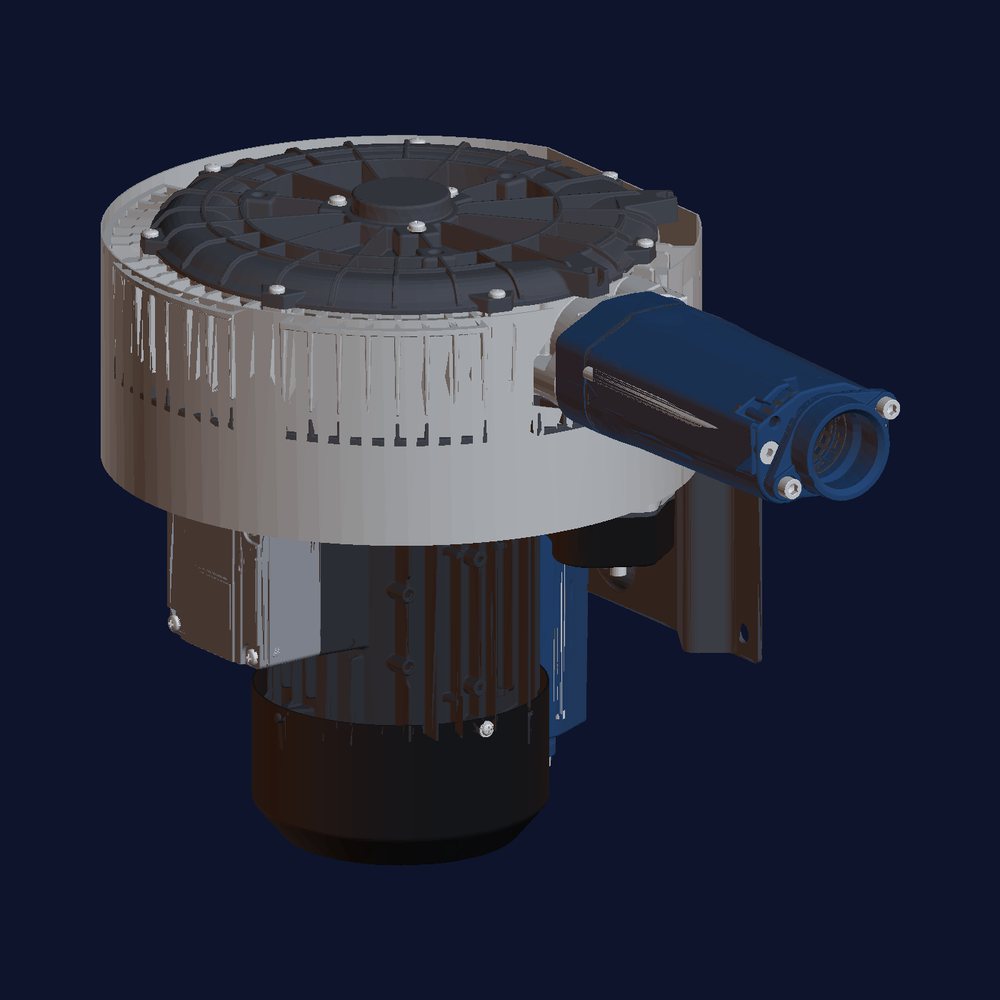
A rotatable 3D model is on the way. Until then the render shows the machine's form, its ports and its mounting arrangement — the same drawing-office view you get on the datasheet.
09Export Readiness
Ready to Ship Worldwide
Double stage blowers are longer and heavier than their single-stage cousins, so freight planning matters. We quote to your Incoterm, crate to the unit's mass class, and wind the motor for your grid — with the two-stage performance report packed inside every crate.
- HS Code
- 8414
- Classification
- Two-stage regenerative blowers classify under HS 8414 alongside single-stage side-channel units. Verify the destination sub-heading with your customs broker.
- Incoterms
- FOB / CIF / EXW (Ex-Works Faridabad)
- Load Ports
- Nhava Sheva (JNPT) · Mundra · Delhi ICD (Tughlakabad)
- Export Packing
- Bolted to a load-rated skid inside an ISPM-15 heat-treated crate; high-HP frames get corner bracing and lifting call-outs. Ports capped, terminal box sealed, desiccant added for sea freight.
- Lead Time
- Common 2–15 HP trims ship in 1–2 weeks; 27–33 HP and special-voltage builds run 3–4 weeks. We stage multi-unit aeration orders to a single coordinated dispatch.
- Power / Frequency
- Wound for 220–440 V, 50 Hz or 60 Hz on request
- Documentation
- Commercial invoice, packing list, ISO 9001:2015 certificate, test report, Certificate of Origin
10Frequently Asked Questions
Answers for Specifiers & Buyers
What actually makes a blower 'double stage'?
Single stage or double stage — how do I choose?
Is the double stage blower still oil-free?
How high can the YEBL-DS pressure and vacuum go?
Does the extra stage make it noisier or hotter?
Can one YEBL-DS cover both high pressure and high vacuum jobs?
11Who Builds It
Since 1998 — 26+ Years of Air Engineering in Faridabad
Double-stage regenerative blowers are the harder build — two channels aligned to a shared shaft, balanced impellers, tighter cooling margins. Yash Blowers has been making them in Faridabad since 1998, and the YEBL-DS shares its impellers and service parts with our single-stage line, so spares are never a bottleneck.
Each unit is tested to its rated point and carries an ISO 9001:2015 certificate. With 10,000+ customers and 300+ units dispatched a day, the pressure figure on the datasheet is one we stand behind on every shipment.
Yash Blowers Private Limited has manufactured blowers and vacuum pumps from its ISO 9001:2015 plant in IMT Faridabad since 1998. Machining, assembly, balancing and testing are done in-house — so the machine you buy is the machine we built, backed by a 12-month warranty and a spares network that keeps decades-old units running.
ISO 9001:2015 · Made in India · 12-Month Warranty
- 1998
- Building air machines
- 26+
- Years in the trade
- 10,000+
- Customers served
- 300+
- Units dispatched / day
Request for Quotation
Get a Quote in 24 Hours
Give us the pressure you must hold at your required flow and we will confirm whether a single or double stage is the economical fit.
Send your duty point — flow, vacuum/pressure and destination port — and our engineers will size the right YEBL-DS model and quote FOB, CIF or EXW. Export packing, HS classification and documentation handled in-house.
Direct line: +91 9971006400 · sales@yashblowers.org