
ACME Series · Oil-Sealed Rotary Vane
High Vacuum Pump
A single-stage oil-sealed rotary vane pump that pulls a genuine 750 mm/Hg ultimate vacuum, in eight sizes from 0.5 to 10 HP. Built for holding, forming, impregnation and process-vacuum duty.
- Ultimate Vacuum
- 750 mm/Hg
- Displacement m³/hr
- 10–302
- Motor Power
- 0.5–10 HP
- ACME Series
- 8 Models
01Overview
Deep Vacuum From a Single Stage
The ACME high vacuum pumpis Yash Blowers’ workhorse oil-sealed rotary vane pump for deep-vacuum industrial duty. Where a side-channel or ring blower tops out around 300–500 mbar of vacuum, the ACME series reaches 750 mm/Hg — about 10 mbar absolute — from a single rotor. That is the difference between merely moving air and actually pulling a process vacuum deep enough to hold a load, draw a resin into a casting, or evacuate a chamber for forming.
Eight models cover the range from the compact ACME-010 (10 m³/hr, 0.5 HP, 20 kg) up to the ACME-302 (302 m³/hr, 10 HP). All eight hold the same 750 mm/Hg ultimate vacuum, so you size on displacement and pump-down time rather than on the vacuum level — the depth is a constant across the series. Every unit is machined, assembled, balanced and vacuum-tested in our Faridabad plant before it ships.
Where it earns its place
The ACME is specified wherever a reliable medium-to-high vacuum has to be held for hours at a time: vacuum holding and clamping fixtures, resin and varnish impregnation of motor windings and transformers, vacuum forming and thermoforming, gas evacuation and back-filling, central vacuum for pick-and-place, drying and moisture removal, and laboratory or pilot-plant rigs that do not need sub-millibar depth. It is a proven, repairable, field-serviceable design — not a sealed black box.
02Working Principle
How Oil-Sealed Rotary Vane Vacuum Works
A slotted rotor is mounted eccentrically inside a cylindrical stator. Vanes ride in the rotor slots and are thrown outward by centrifugal force so their tips sweep the bore. Because the rotor sits off-centre, the crescent-shaped space between rotor and stator continuously grows on the inlet side — drawing gas in — and shrinks on the outlet side, compressing that gas and pushing it out past the discharge valve.
The trick that lets a single stage reach 750 mm/Hg is oil. A metered film of vacuum oil seals the microscopic clearance between vane tip and bore, so the compressed gas cannot leak back to the inlet. The same oil lubricates the vanes against wear and carries heat of compression out to the reservoir. Seal, lubricate, cool — one fluid doing three jobs is why the design is compact, quiet and efficient.
The role of gas ballast
When you pump vapours — moisture, solvents — they can condense inside the pump and contaminate the oil. A gas-ballast valve bleeds a controlled amount of air into the compression stage so vapour is swept out before it condenses. Open the ballast when handling wet loads; close it for the deepest dry vacuum. This single feature is what keeps an oil-sealed pump healthy on real process gas rather than clean bench air.
Why not just use a blower?
Regenerative and centrifugal blowers move large air volumes but at shallow vacuum. A rotary vane pump moves less volume but reaches a far deeper vacuum and holds it against leakage. For any duty defined by a vacuum level rather than an airflow, the ACME is the correct tool — and for very large volumes at deep vacuum, a rotary vane pump is often backed by a booster.
03Selection Guide
Choosing the Right ACME Model
Sizing a vacuum pump is about time, not just depth. Every ACME model reaches the same 750 mm/Hg, so the question is how fast you need to get there and how much leakage and outgassing the pump must overcome to stay there.
- Estimate the volume to evacuate — chamber, hose, manifold and any downstream vessels, in litres or m³.
- Decide an acceptable pump-down time. A rough guide: pick a displacement (m³/hr) that evacuates your total volume several times over within that time, because pumping slows as pressure drops.
- Add margin for leakage and outgassing. Real systems leak at fittings and seals; wet or porous loads outgas. A pump sized with no margin will run continuously and never settle.
- Match the model. ACME-010/020 suit benches and small fixtures; ACME-040/063/100 cover mid-size forming and impregnation; ACME-140/202/302 handle large chambers and central-vacuum headers.
Note the 2800 rpm ACME-020 if space and weight matter — it delivers 20 m³/hr from the same 20 kg frame as the ACME-010 by spinning faster. For continuous heavy duty, the slower-turning 1400 rpm models generally run cooler and wear more slowly. Send us your chamber volume and target time and we will confirm the model — no guesswork.
04Performance Data
Full Specifications — All 8 Models
Complete data for all eight ACME models — free-air displacement in both m³/hr and LPM, ultimate vacuum, sound level, weight and speed. Values are as published; tap any model chip to jump to its row.
Full specification · 8 models · Series ACME
0 – 10
0 – 302 m³/hr
Showing 8 of 8 models
| Model | Power | Displacement(m³/hr) | Displacement(LPM) | Ultimate Vacuum | Sound Level(dB) | Weight(kg) | Speed(RPM) | Action |
|---|---|---|---|---|---|---|---|---|
| ACME-010 | 0.5 HP | 10 | 167 | 750 (mm/hg) | 64 | 20 | 1400 | Get Quote |
| ACME-020 | 1.0 HP | 20 | 334 | 750 (mm/hg) | 64 | 20 | 2800 | Get Quote |
| ACME-040 | 2.0 HP | 40 | 667 | 750 (mm/hg) | 67 | 50 | 1400 | Get Quote |
| ACME-063 | 3.0 HP | 63 | 1050 | 750 (mm/hg) | 68 | 83 | 1400 | Get Quote |
| ACME-100 | 4.0 HP | 100 | 1667 | 750 (mm/hg) | 72 | 87 | 1400 | Get Quote |
| ACME-140 | 5.0 HP | 140 | 2333 | 750 (mm/hg) | 73 | 115 | 1440 | Get Quote |
| ACME-202 | 6.0 HP | 202 | 3367 | 750 (mm/hg) | 78 | 126 | 1400 | Get Quote |
| ACME-302 | 10 HP | 302 | 5033 | 750 (mm/hg) | 75 | 87 | 1400 | Get Quote |
05Construction
Materials & Build
The ACME is built to be rebuilt, not replaced. Every wear part is a stock item.
- Stator & end covers: close-grained cast iron, bored and honed for a true cylindrical seal surface that vanes can ride for years.
- Rotor: hardened steel, dynamically balanced so the pump runs smooth and quiet — the smallest models sit at 60–64 dB.
- Vanes: high-grade carbon / composite vanes that self-adjust to the bore as they wear and are replaced as a simple service item.
- Shaft seal: oil-tight radial seal on the drive shaft; the reservoir includes a sight glass for at-a-glance level and oil-condition checks.
- Motor: TEFC induction motor, foot or flange mounted, wound for your supply — 220–440 V, 50 or 60 Hz.
The result is a pump that a plant fitter can service on the bench with hand tools: drain, split, swap vanes, re-oil, re-test. No proprietary consumables, no send-back-to-factory rebuilds.
06Install & Maintain
Installation & Maintenance
Installation
- Mount on a flat, rigid base; leave clearance around the fan cowl for cooling air. Keep ambient below 40 °C.
- Fit a suction filter (YEBL-FA) at the inlet — dust is the fastest way to score a bore and ruin oil.
- Fit an anti-suckback / non-return valve so oil cannot be drawn back into the chamber when the pump stops under vacuum.
- Use full-bore hose and short, straight inlet runs; every elbow and restriction costs you pump-down speed.
- Fill with the specified vacuum oil to the sight-glass line before first start. Check rotation direction.
Maintenance schedule
- Weekly: check oil level and colour through the sight glass; clear the inlet filter.
- Every 500–2,000 hours: change the vacuum oil — sooner for wet or dirty gas, later for clean dry air.
- At each oil change: inspect vanes for wear and chipping; replace as a set when they reach their limit.
- Annually: check the shaft seal, motor bearings and coupling; verify ultimate vacuum against 750 mm/Hg with a gauge.
Follow this and an ACME pump runs for years. Ignore the oil and no vacuum pump — from any maker — will hold its rating.
If the Vacuum Falls Short
Most vacuum complaints trace back to oil, a leak or a filter — not to the pump itself. Work through these before condemning the machine.
- Will not reach 750 mm/Hg — check for an inlet leak first (a single loose fitting caps the vacuum), then low or dirty oil, a clogged suction filter, or vanes at their wear limit. Fix in that order.
- Oil turned milky or emulsified — vapour is condensing into the oil. Open the gas ballast and run the pump warm to purge it; fit an inlet trap on wet duty; change the oil if it stays contaminated.
- Pump running hot — clear the cooling fins and fan cowl, confirm ambient is below 40 °C, and verify the pump is not being asked to hold more airflow than its rating.
- Oil found in the vacuum line or chamber — oil is being drawn back on shutdown. Fit an anti-suckback / non-return valve at the inlet.
- Noisy or vibrating — inspect for worn or chipped vanes and check the motor bearings and coupling.
07Applications
Where the ACME Series Works
- Vacuum holding & clamping — CNC fixtures, printing and lamination beds, pick-and-place.
- Impregnation — resin and varnish impregnation of motor windings, transformers and coils.
- Vacuum forming & thermoforming — packaging, trays, automotive and appliance parts.
- Degassing & gas evacuation — removing entrained air from liquids, potting compounds and adhesives.
- Drying & moisture removal under vacuum, with gas ballast for the vapour load.
- Central vacuum systems feeding multiple stations from one header.
- Laboratory & pilot plant rigs needing a dependable medium-to-high vacuum.
083D / Interactive View
Inspect the Machine Closer
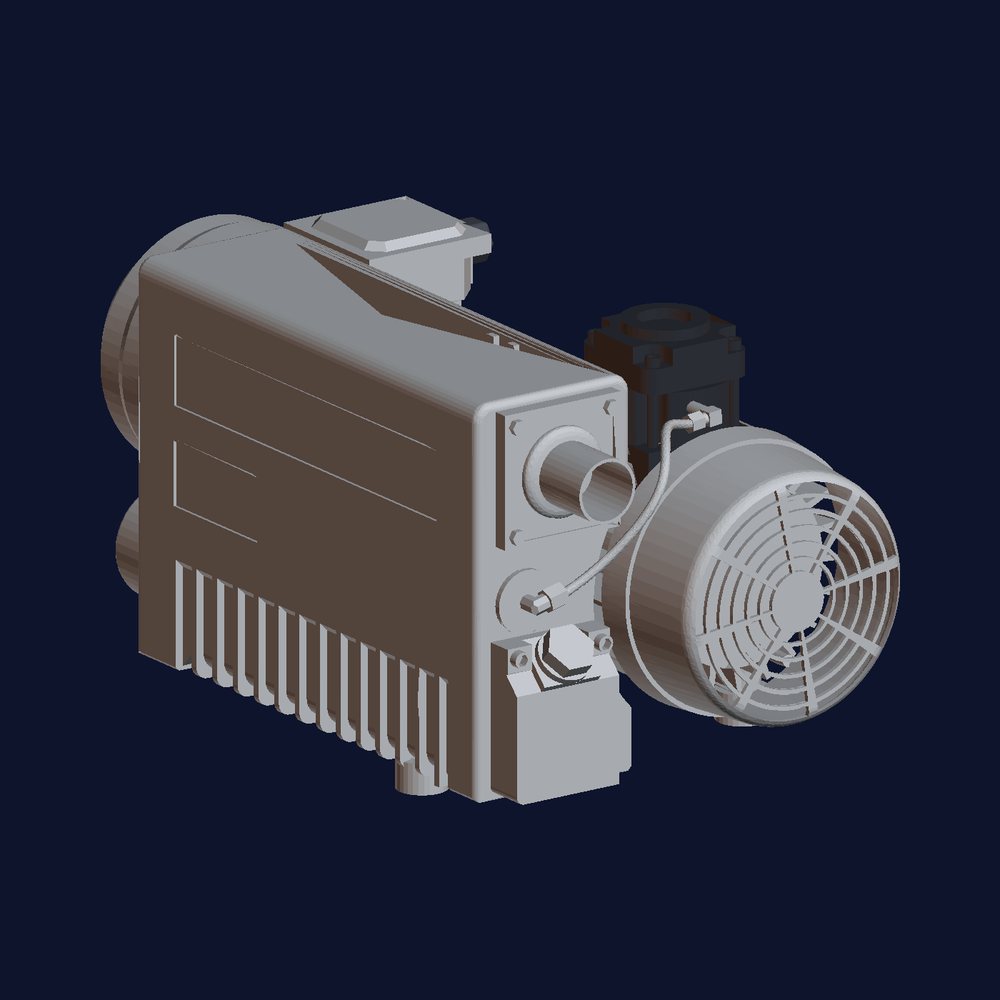
A rotatable 3D model is on the way. Until then the render shows the machine's form, its ports and its mounting arrangement — the same drawing-office view you get on the datasheet.
09Export Readiness
Ready to Ship Worldwide
We have shipped to buyers across the Gulf, South-East Asia, Africa and Latin America. Every consignment leaves Faridabad export-packed, documented and correctly classified — quote us your port and Incoterm and we handle the rest.
- HS Code
- 8414.10.00
- Classification
- Vacuum pumps — air or gas pumps (oil-sealed rotary vane)
- Incoterms
- FOB / CIF / EXW (Ex-Works Faridabad)
- Load Ports
- Nhava Sheva (JNPT) · Mundra · Delhi ICD (Tughlakabad)
- Export Packing
- Fumigated wooden crates (ISPM-15), oil drained for transit, desiccant and inlet/outlet blanking
- Lead Time
- 1–3 weeks ex-stock for common ACME models; 3–5 weeks for larger sizes
- Power / Frequency
- Wound for 220–440 V, 50 Hz or 60 Hz on request
- Documentation
- Commercial invoice, packing list, ISO 9001:2015 certificate, test report, Certificate of Origin
10Frequently Asked Questions
Answers for Specifiers & Buyers
What ultimate vacuum does the ACME high vacuum pump reach?
Is the ACME pump oil-sealed or oil-free?
How do I size the right ACME model for my application?
What maintenance does an oil-sealed rotary vane pump need?
Can the pump run continuously, 24/7?
Do you export the ACME high vacuum pump, and under what terms?
11Who Builds It
Since 1998 — 26+ Years of Air Engineering in Faridabad
Yash Blowers Private Limited has manufactured blowers and vacuum pumps from its ISO 9001:2015 plant in IMT Faridabad since 1998. Machining, assembly, balancing and testing are done in-house — so the machine you buy is the machine we built, backed by a 12-month warranty and a spares network that keeps decades-old units running.
ISO 9001:2015 · Made in India · 12-Month Warranty
- 1998
- Building air machines
- 26+
- Years in the trade
- 10,000+
- Customers served
- 300+
- Units dispatched / day
Request for Quotation
Get a Quote in 24 Hours
Send your duty point — flow, vacuum/pressure and destination port — and our engineers will size the right ACME model and quote FOB, CIF or EXW. Export packing, HS classification and documentation handled in-house.
Direct line: +91 9971006400 · sales@yashblowers.org